Your membership has expired

The payment for your account couldn't be processed or you've canceled your account with us.

Re-activate

Mazda CX-5 First Drive

Summary

Introduction

Review: 2026 Mazda CX-5 Has a Roomy Interior But Lacks a Hybrid Version

While exterior styling updates from the previous CX-5 are minor and the powertrain hasn’t changed, Mazda’s compact SUV has more safety features and a new infotainment system

Overview

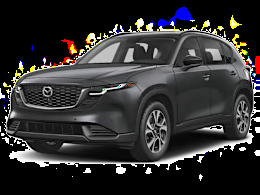
The 2026 Mazda CX-5 doesn’t look dramatically different from the small SUV’s previous generation, and it uses the same basic engine and transmission. It’s only inside the cabin where major changes have taken place.

Mazda sells two compact SUVs: the CX-5 and the CX-50. The CX-5 is built in Japan and sold in different markets around the world, while the CX-50 is designed for and manufactured in the United States.

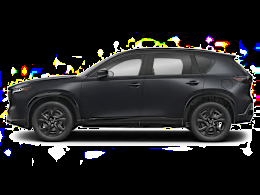
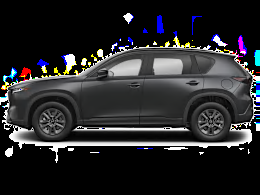
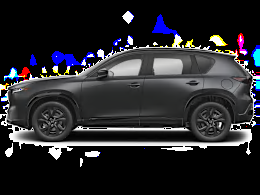
The redesigned CX-5 is ever-so-slightly larger than the outgoing model, with the majority of the growth coming in the wheelbase, which is 4.5 inches longer. It’s also 3.2 inches taller than the CX-50.

It is odd that Mazda’s two compact SUVs compete against each other. Although the 2026 CX-5 has just five trims, down from the 2025 CX-5’s eight, there is still significant price overlap with the CX-50.

Only the CX-50 hybrid and turbocharged versions cost more than the CX-5.

Mazda says the CX-5 is focused on on-road performance, while the CX-50 is geared toward adventure-seeking buyers, although it lacks mechanical features to make it more off-road capable.

The final assembly point of the CX-5 is Hiroshima, Japan.

It competes with the Ford Escape, Honda CR-V, Hyundai Tucson, Jeep Compass, Kia Sportage, Mazda CX-50, Nissan Rogue, Subaru Forester, Toyota RAV4, and Volkswagen Tiguan.

Mazda loaned Consumer Reports a 2026 CX-5 Premium Plus, the top trim level, for this First Drive Review. We will buy a CX-5 Preferred, which is the middle trim, for our road-test program as soon as the CX-5 is available at Mazda dealers.

Impressions

What We Like

Ride

The new CX-5 feels as if the suspension does a better job of keeping it settled and absorbing impacts than its predecessor. It feels more softly sprung than Mazda vehicles from the past few years, and it did a good job preventing the harshness of hitting a pothole or pavement seam from punching into the cabin. Mid-corner bumps were shrugged off, with the rear of the SUV staying under control. As one tester put it, “[I] can see customers being pretty darn happy with the ride quality” of the new CX-5.

Handling

Even with the softer ride, the CX-5 feels nimble, controllable, and better than most of its competitors. It may have lost a little bit of Mazda’s traditional sporty handling character, particularly because of the lighter steering effort, but it still has strong grip when diving into a corner carrying speed. Testers found that it was easy and drama-free to adjust their driving line mid-corner without upsetting the SUV. There’s no indication that the Premium Plus has different tires than the Preferred we plan to buy, and both ride on 19-inch wheels. But we’ll see just how much of the athleticism from the last CX-5 was carried over to the new one when we put our purchased CX-5 through our different handling tests on our track.

Touchscreen

The 2026 CX-5 is the first model with Mazda’s new controls and infotainment system. Gone is the rotary knob that made it challenging to navigate the system, and the “not a touchscreen, except it’s a touchscreen when using Android Auto and Apple CarPlay” display.

In its place is a larger touchscreen that houses nearly all the controls. The Premium Plus trim gets a 15.6-inch display, while all the other trims (including the Preferred trim we will buy for our test program) get a 12.9-inch center display.

We’re happy to finally see the rotary knob being phased out, although the new system leaves much to be desired

Cabin access

Getting into and out of the CX-5 is mostly easy. There’s a narrow door sill to step over, and the seat height makes it easy to slide right in. The lack of aggressive bolsters on the back and bottom cushions helps out. A few testers said that the comfort exit function, which pushes the seat back to make it easier to get out, is helpful but a pain to set up.

Traditional controls

It’s a sad state of the industry when an automaker keeping straightforward, easy-to-use controls is celebrated. But that is where we are. Fortunately, Mazda got it right with the mechanical gear selector for the six-speed automatic, the clear turn-signal and windshield-wiper stalks on the steering wheel, standard window controls, and regular dash vents with manual airflow adjustments.

Camera view

There’s a button on the steering wheel that activates the camera view, which is displayed on the center screen. “The new camera view button on the steering wheel is genius,” said one tester. “Every car with a surround view camera should have a button this easy to access.”

Standard safety

One area where Mazda stands out from many other automakers is the number of active safety features that are standard across all trim levels. In addition to automatic emergency braking with pedestrian detection, blind spot warning, and rear cross traffic warning, the CX-5 comes with rear cross traffic braking and rear pedestrian detection braking, as well as an alert and braking to prevent accidents when making a turn across traffic. While these systems aren’t unique to Mazda, the automaker continues to prioritize safety as a no-extra-cost option. For more on the CX-5’s features, see the “Safety and Driver Assistance” section below.

What We Don't Like

Controls and usability

Mazda’s new controls strategy is a step backward. There’s no other way to put it. The automaker took away nearly every physical control, save what was mentioned above. Everything, including commonly used controls and features, is accessed through the infotainment system.

On the surface, and in the showroom, the display looks bright, airy, and high-tech. But using the various controls while driving is a different matter. As one tester put it, “There is a correct ratio of screen to physical buttons, and the CX-5 doesn’t have it.”

For example, there’s no longer a volume knob. It’s replaced by an on-screen slider that is accessed by first tapping the screen. At least the driver gets thumb-controlled volume buttons on the steering wheel, which proved a reach for testers with smaller hands.

For the Seinfeld fans: "I have a lot of problems with these climate controls, and now you’re gonna hear about it!" While changing the temperature on the screen is straightforward because it’s always there, other adjustments require wading through the menu structure. Fan speed adjustments require multiple steps to access and taps to adjust.

Want to put on the seat heaters and steering wheel heat when jumping in on a cold day? First, wait for the system to initialize, then go into a menu. Want to turn off the engine stop/start system? You’ll have to go through a few steps on the screen, rather than pressing a physical button on the center console or dashboard. Adjusting the head-up display and brightness levels for the instrument panel and center screen is all located in a menu that is really challenging to access and adjust while driving at night.

Mazda’s well-designed steering wheel controls were also binned at the same time as the physical climate controls. In their place are pads that are flat and share panels, which makes them difficult to use without looking down at them.

The app screen for the infotainment system is a massive collection of icons arranged in rows and columns. It’s overwhelming to look at and a challenge to find and make selections while driving.

Now, Mazda’s gone full-in on Google Built-In, including the Voice Assistant. So long as owners have Mazda Connected Services active (free for the first year on the 2026 CX-5), they can use voice controls to make many adjustments, such as volume, temperature, and fan speed, among others. But there’s a fee for this service, $15 per month after the trial period. Owners who forgo it lose the voice control capability.

Fit and finish

The cabin is a letdown compared with the previous-generation CX-5 and both versions of the CX-50 we tested. What makes it worse is that the CX-5 Mazda loaned us is the top Premium Plus trim.

“For a $41,000 vehicle, there shouldn’t be this much plastic,” said one tester. “This is one of the most depressing areas of the vehicle compared to Mazda’s past,” said another.

There’s hard plastic everywhere, including the center console and shroud over the instrument panel. The upper, middle, and lower sections of the dashboard are plastic, as are most of the door panels. Even the padded sections on the door and the center armrests feel thin, especially compared with the CX-50s we tested. There’s no padding for the driver’s right knee on the center console, and we noticed numerous uneven panel gaps on the center console and dashboard.

One tester summed it up well, saying, “If you slapped a different automaker’s badge on the steering wheel, I wouldn’t even bat an eye because this just doesn’t look or feel like the Mazda I know.”

Seat adjustments and memory

Numerous testers had problems with the CX-5’s seat memory. No matter what they did, the seat would return to the lowest, furthest-back position every time they started the car. There’s a feature called “Ideal Driving Position,” but this didn’t work reliably.

The lack of hard buttons for seat memory makes the process worse, as the driver needs to navigate a menu to find the controls to select a saved position. In theory, the keys would be linked with the system so it would adjust the seats when the driver got in, but that didn’t work, either.

Even though the CX-5 we borrowed is a production model, it’s possible that there is a software issue that requires an update to address this.

What We'll Keep an Eye On

Seats

Our testers found the full leather seats in the Premium Plus we borrowed to be comfortable and better than those in the CX-50, but not stellar. They are comfortably padded, a big difference from the overly hard seats in the CX-50, and have minimal bolstering on the bottom cushion and backrest. The pronounced lumbar support drew praise from most drivers, though a few found it too prominent for their taste.

One tester noted that the bottom cushion was too short to provide enough leg support, and that there was a “dead spot,” where the bottom cushion and backrest meet, that failed to adequately support his back.

We plan to purchase the midlevel Preferred trim, which offers the same 10-way adjustability as the top two trims. It’s described as “half leatherette,” and we’ll see if there are any fundamental differences in comfort compared with the full leather seats.

Powertrain

Mazda carried over the engine and transmission from the previous CX-5, with a few adjustments, such as new tuning to make the transmission downshift more quickly in certain situations. But even so, the general consensus is that power is at best adequate, bordering on insufficient.

On the positive side, power comes on quickly but not abruptly, and the CX-5 doesn’t surge uncontrollably or unexpectedly.

Fuel economy

The previous-generation CX-5 got 24 mpg overall in our road tests, and achieved 17 mpg in the city evaluation and 33 mpg in our highway tests. Its overall fuel economy placed it toward the bottom of the list of nonhybrid small SUVs. Drivers noted that they averaged about 26 mpg in the new CX-5, and that the cruising range was about 400 miles, with neither figure being a standout compared with competing SUVs.

We’ll see how our own CX-5 performs in our real-world on-road fuel economy tests.

Noise

Most testers found the CX-5’s cabin to be loud, particularly on the highway. The vocal engine sounds coarse, and road noise was excessive, creating a cacophony that multiple testers noted. At lower RPMs, the engine sound settles into the background, but when it is called upon for acceleration, it becomes unpleasant-sounding. “Mazda claims that more sound-deadening material was added to this version,” said one tester, “but I don’t think they went far enough.”

Safety and Driver Assistance Systems

All CX-5 trims come standard with automatic emergency braking with pedestrian detection, blind spot warning, rear cross traffic warning, lane departure warning, lane keeping assistance, adaptive cruise control, and automatic high beams. The SUV also comes standard with systems to prevent accidents when turning across traffic, automatic braking when reversing to avoid hitting pedestrians or vehicles, automatic steering corrections for the blind spot system, and steering assistance to avoid a head-on collision. Many of these are new features.

The Premium Plus trim features a Level 2 active driving assistance system called Cruising and Traffic Support. It uses a driver monitoring camera to determine whether the driver is looking forward and to facilitate assisted lane changes when the driver uses the turn signal. The system includes Unresponsive Driver Support, which will bring the car to a safe stop in the event the driver is incapacitated and does not respond to the driver monitoring system prompts.

Change Vehicle