Your membership has expired

The payment for your account couldn't be processed or you've canceled your account with us.

Re-activate

2027
Slate EV Pickup

EPA Range: 205 miles

Slate EV Pickup First Drive

Summary

Introduction

Bare-Bones All-Electric Slate Truck or SUV Starts Under $25,000

A small two-seat pickup that you can convert to an SUV promises to be an antidote to giant vehicles, high prices, and complex technology

Overview

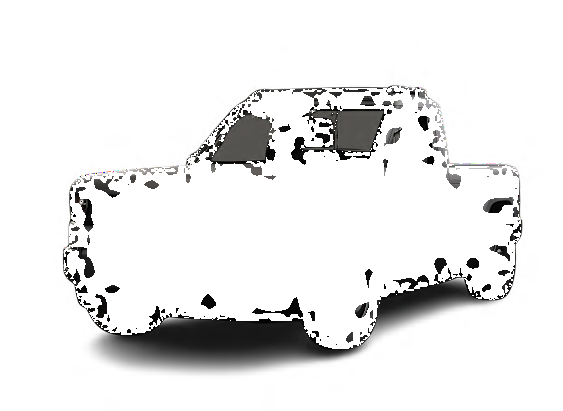
Slate is a totally new all-electric vehicle brand that’s going to sell only one vehicle: a small electric two-door pickup truck with virtually no factory options. It doesn’t have an infotainment screen, and it doesn’t even have power windows. Squared-off, "fastback," and "open-air" SUV versions are available, either as a factory conversion or a do-it-yourself kit.

As trucks get bigger, technology gets more complex, and car prices get higher, Slate has taken a different approach. It has almost entirely manual controls and very few creature comforts. Truly a small truck, it measures about 2 feet shorter than the Ford Maverick. The entry-level Blank Slate pickup starts at $24,950 before a mandatory destination charge and fees.

Consumer Reports paid to reserve a Slate Squareback SUV, with an MSRP of $29,950. It’s expected to arrive at our test track next summer.

While the truck comes only in black, Slate offers customizable vinyl wraps in a broad spectrum of colors, priced under $500. They can provide a full-body wrap, or just portions, creating many ways to personalize the truck. It has an estimated range of 205 miles between charges from a 63-kWh battery and a NACS charger.

Slate says the parts of the pickup that aren’t assembled in your driveway will be built in the U.S., so the EV will qualify for a $7,500 EV tax credit as long as it’s still available. Regardless of tax credits and tariffs, the Slate’s Made-in-U.S.A. label means it won’t be subject to prohibitive taxes on compact pickups that have kept foreign manufacturers from importing their tiniest trucks.

It’s a truly unique vehicle, and we’re looking forward to purchasing one and testing it, along with all the kits necessary to customize it.

What it competes with is Nothing, really—maybe a pristine 1972 Chevy LUV?

It comes in a 181-hp single electric motor, 63-kWh lithium-ion battery, and rear-wheel drive.

Price range is $24,950 to $40,000.

The on sale date is 2027.

The final assembly point is Warsaw, Indiana (and your driveway).

Impressions

Outside

The base Slate looks a lot like the truly compact pickup trucks that were popular in the ’70s and ’80s, like the Chevrolet LUV, Ford Courier, and Datsun 620. It’s a two-door, two-seater that’s just under 70 inches tall and just over 174 inches long—about as long as a Mini Countryman and as tall as a Ford Maverick. The bed is 5 feet long and 42.9 inches wide between the wheel wells, but at least 50 inches wide above them, so it would be possible to fit plywood or drywall with some maneuvering. There’s a 7-cubic-foot frunk for enclosed storage under the hood.

The styling is extremely basic. It comes with 17-inch steel wheels, and the only available paint color is black. Although it can be customized with different colored wraps. There’s a lot of plastic cladding, too. It’s low to the ground, which makes for easy loading. The 5-foot bed is longer than the bed on many current midsized trucks, which have compromised bed length for crew cab configurations.

Add the SUV kit and you can choose between a traditional boxy SUV or a fastback with a slanted rear window. The kit doesn’t add doors, so passengers will have to scoot behind the front seats.

Just as Volkswagen Beetle owners customized their cars in the ’60s and ’70s, turning them into everything from open-air dune buggies to fake Rolls-Royces, Slate showed off a bunch of unique configurations for its pickup truck. With enough money and enough accessories, you can build a low rider, a beach cruiser, a work truck, or a family hauler.

Inside

The interior is extremely spartan. You’ll be impressed by the Slate’s creature comforts only if you currently drive a delivery van for UPS or the U.S. Postal Service. There are knobs for climate control (air conditioning comes standard), crank windows, a traditional turn signal indicator, a column shifter, buttons for cruise control, and a spot to put a phone or tablet. Beneath the infotainment holder is a space for a Bluetooth speaker. The only screen is a gauge cluster with a speedometer. Thankfully, it’s behind the steering wheel and not in the center of the truck.

If you add the SUV kit, you’ll also have to add roll bars that improve strength in a crash but visibly intrude into the rear cargo space. As boxy as the Slate SUV is from the outside, the interior is a bit more curved.

What Drives It

A single 150-kilowatt electric motor drives the rear wheels. All-wheel drive is not an option. Towing capacity is only around 1,000 pounds, and the bed can hold about 1,400 pounds. Acceleration from 0 to 60 mph should take a respectable 8 seconds, according to company estimates, and top speed is 90 mph.

The standard 52.7-kilowatt-hour battery pack is claimed to get about 150 miles between charges, while an accessory 84.3-kWh pack will be able to handle about 240 miles. The Slate comes with a standard Tesla-style NACS charging port. Its maximum charging acceptance rate is a decent 120 kW, and the company says the battery can go from 20 percent to 80 percent charged at a DC fast charger in under 30 minutes.

Safety and Driver Assistance Systems

Slate says its new EV is designed to achieve five-star safety ratings in NHTSA’s crash tests, which is an admirable goal. However, we’re more interested in how it performs in stricter crash tests from the Insurance Institute for Highway Safety (IIHS). Front and side curtain airbags come standard, and additional curtain airbags are included in the bolt-on SUV kit.

There’s a difference between technology that claims to make driving less stressful and technology that actually prevents crashes. We wouldn’t mind if the Slate eschewed features like lane centering or adaptive cruise control, which some of our members say can beep relentlessly or steer too aggressively.

However, other features are actually proved to prevent crashes and injuries. We’re very glad to see that one of these features—AEB—is standard on the Slate, likely due to anticipated federal safety rules. Similarly, a mandatory backup camera is displayed on the screen behind the steering wheel. But there’s no word on whether owners can opt for other active safety features that are proved to prevent crashes, such as blind spot warning or rear cross traffic warning.

Change Vehicle